- Call : +91 9540210956
- Email: info@chestsurgeryindia.com
- Artemis Hospital Sector 51 Gurgaon
- 09Am - 5Pm


Surgery vs. Endoscopic Resection for T2N0M0 Lung Cancer: What’s the Safer Option?
- Home
- Blog Details
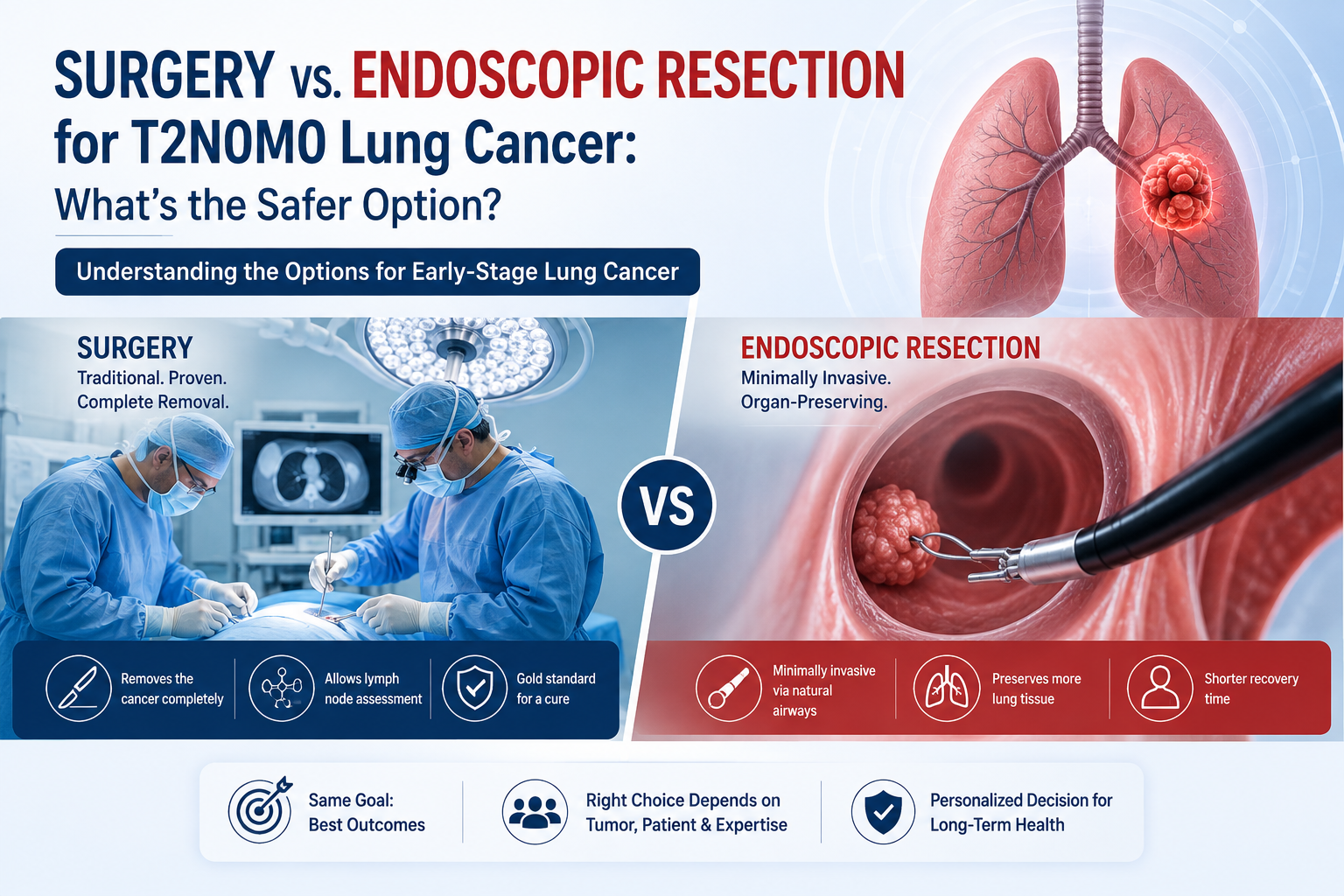
Receiving a lung cancer diagnosis can be overwhelming. Along with the fear and uncertainty, patients and their families often have to understand unfamiliar medical terms and make important treatment decisions in a short period of time.
If your doctor has diagnosed you with T2N0M0 non-small cell lung cancer (NSCLC), the important thing to understand is that the cancer is still localized. Depending on the exact tumour size and characteristics, T2N0M0 generally corresponds to Stage IB or Stage IIA lung cancer, where treatment may still be given with curative intent.
You may come across several treatment options, including surgery, SBRT, thermal ablation, and procedures sometimes described as "endoscopic" treatments. But how are these treatments different, and which option is most appropriate?
This guide explains what T2N0M0 means, the major treatment options available, and how they compare in terms of effectiveness, recovery, risks, and long-term outcomes.
Understanding T2N0M0 Lung Cancer
T2N0M0 comes from the TNM staging system, which doctors use to describe how far a cancer has progressed.
T - Tumour
The T describes the size of the primary tumour and whether it has involved nearby structures.
T2 generally means that the tumour is larger than 3 cm but not larger than 5 cm. A tumour may also be classified as T2 because of certain characteristics, such as involvement of the main bronchus or visceral pleura.
T2 is further divided into:
T2a: tumour larger than 3 cm but not larger than 4 cm
T2b: tumour larger than 4 cm but not larger than 5 cm
N - Lymph Nodes
The N describes whether the cancer has spread to nearby lymph nodes.
N0 means that no regional lymph-node involvement has been detected. This is important because it suggests that the cancer remains localized rather than having spread through the lymphatic system.
M - Metastasis
The M describes whether cancer has spread to distant parts of the body.
M0 means that no distant metastasis has been detected, such as spread to the other lung, liver, bones, brain, or other organs.
What Does T2N0M0 Mean Overall?
Taken together, T2N0M0 describes localized, early-stage lung cancer without detected lymph-node or distant spread.
Depending on whether the tumour is classified as T2a or T2b and other staging factors, it generally falls within Stage IB or Stage IIA NSCLC.
Treatment decisions should ideally be made through a multidisciplinary team (MDT) involving specialists such as a thoracic surgeon, medical oncologist, radiation oncologist, pulmonologist, and other relevant clinicians.
Surgery: The Standard Treatment for Operable Disease
For patients with T2N0M0 NSCLC who are medically fit for an operation, surgical removal of the cancer is generally the preferred treatment approach.
Surgery has two major advantages:
Removal of the tumour: The cancer and an appropriate margin of surrounding tissue can be physically removed.
Accurate pathological staging: Nearby lymph nodes can be removed and examined under a microscope. This can reveal microscopic lymph-node involvement that may not have appeared on imaging and can influence whether additional treatment is recommended.
Lobectomy
A lobectomy involves removing the entire lobe of the lung containing the tumour.
The right lung contains three lobes, while the left lung contains two. Removing the affected lobe allows the surgeon to remove the tumour along with surrounding tissue and associated lymphatic pathways.
For many patients with operable T2 disease, lobectomy with appropriate lymph-node assessment remains an important surgical approach.
What About Smaller Lung-Sparing Operations?
Other surgical procedures include:
Segmentectomy: removal of an anatomical segment of the lung
Wedge resection: removal of the tumour with a smaller surrounding portion of lung tissue
These procedures preserve more lung tissue and may be considered in selected patients depending on tumour characteristics, location, lung function, and overall health.
For larger T2 tumours, however, the appropriate extent of surgery needs to be carefully evaluated by the thoracic surgical team.
Minimally Invasive Lung Cancer Surgery
Lung cancer surgery does not always require a large chest incision. Many early-stage tumours can now be treated using minimally invasive techniques.
VATS
Video-Assisted Thoracoscopic Surgery (VATS) uses several small incisions through which a camera and specialized surgical instruments are introduced into the chest.
The surgeon performs the operation while viewing the chest cavity on a high-resolution monitor.
Robotic-Assisted Thoracic Surgery
Robotic-Assisted Thoracic Surgery (RATS) follows similar minimally invasive principles but uses robotic instruments controlled by the surgeon from a console.
The system can provide magnified visualization and highly controlled instrument movement.
Compared with traditional open thoracic surgery, minimally invasive approaches can offer benefits such as:
Smaller incisions
Less postoperative pain
Reduced blood loss
Shorter hospital stay
Faster recovery
The most suitable surgical technique depends on tumour location, complexity, the patient's condition, and the surgeon's expertise.
Risks of Lung Cancer Surgery
Lobectomy is a major operation, and complications can occur.
Potential risks include:
Persistent air leak
Bleeding
Infection
Postoperative pain
Irregular heartbeat, particularly atrial fibrillation
Respiratory complications
The individual risk varies considerably depending on age, lung function, cardiovascular health, other medical conditions, and the complexity of the operation.
What If Surgery Is Not Possible?
Not every patient can safely undergo lung surgery.
Severe heart disease, significantly reduced lung function, COPD, frailty, or other medical conditions may make surgery too risky. Some patients may also choose not to undergo an operation.
In these situations, non-surgical treatments such as Stereotactic Body Radiation Therapy (SBRT) or, in selected cases, thermal ablation may be considered.
What Does "Endoscopic Resection" Mean?
The term endoscopic resection can sometimes cause confusion when discussing lung cancer.
Bronchoscopy uses a thin flexible or rigid instrument to examine the airways. It is extremely useful for diagnosing lung cancer and can also be used to treat certain tumours or obstructions located inside the airways.
However, a typical 3–5 cm T2 tumour located within the lung tissue cannot usually be completely removed through a bronchoscope.
For localized lung tumours where surgery is not suitable, treatments such as SBRT and thermal ablation are generally more relevant alternatives.
Thermal Ablation: RFA and MWA
Thermal ablation destroys tumour tissue using extreme temperatures.
Two commonly used techniques are:
Radiofrequency Ablation (RFA): uses radiofrequency energy to generate heat and destroy tumour cells.
Microwave Ablation (MWA): uses microwave energy to rapidly heat and destroy tumour tissue.
These procedures are usually performed percutaneously, meaning through the skin.
Using CT imaging for guidance, an interventional radiologist places a thin probe directly into the tumour and delivers energy to destroy the targeted tissue.
Who May Benefit From Ablation?
Thermal ablation tends to work best for smaller tumours, particularly those below approximately 3 cm.
As tumour size increases, achieving complete destruction of the entire tumour becomes more difficult, which can increase the risk of local recurrence.
Risks of Thermal Ablation
One of the most common complications is pneumothorax, or a collapsed lung, because the treatment probe must pass through lung tissue.
Other possible complications include:
Bleeding
Pain
Pleural effusion
Infection
Some patients who develop a significant pneumothorax may temporarily require a chest tube.
SBRT: Highly Focused Radiation Treatment
Stereotactic Body Radiation Therapy (SBRT) is an advanced form of radiation therapy that delivers highly focused doses of radiation directly to the tumour.
Treatment planning accounts for tumour location and movement during breathing, allowing radiation to be concentrated on the cancer while limiting exposure to surrounding healthy tissue.
Unlike surgery or ablation, SBRT does not require an incision or a needle to be placed into the tumour.
Treatment is usually delivered over a small number of sessions.
Who Is SBRT For?
SBRT is an established treatment option for patients with early-stage NSCLC who:
Are medically unable to undergo surgery
Have an unacceptably high surgical risk
Decline surgery after discussing the available options
Risks and Side Effects
Most patients tolerate SBRT relatively well, although side effects can occur.
These may include:
Fatigue
Cough
Chest discomfort
Shortness of breath
Radiation pneumonitis
Radiation pneumonitis is inflammation of lung tissue following radiation therapy. When clinically significant, it may cause cough or breathlessness and may require treatment.
Surgery vs SBRT vs Thermal Ablation
The meaning of "safer" depends on whether we are considering short-term procedural risk or long-term cancer control.
For medically fit patients, surgery provides removal of the tumour together with pathological examination of the lymph nodes and remains an important standard treatment for operable early-stage NSCLC.
SBRT avoids an operation and generally has a considerably shorter initial recovery period, making it particularly valuable for patients who cannot safely undergo surgery.
Thermal ablation can also provide a minimally invasive option in carefully selected patients, particularly when tumours are relatively small.
| Feature | Lobectomy (VATS/Robotic) | SBRT | Thermal Ablation (RFA/MWA) |
|---|---|---|---|
| Procedure | Surgery | Focused radiation | Image-guided needle procedure |
| Incision | Small surgical incisions | None | Small needle puncture |
| Hospital Stay | Usually several days | Usually outpatient | Outpatient or short stay |
| Recovery | Usually several weeks | Generally short | Generally short |
| Lymph Node Assessment | Yes | No surgical assessment | No surgical assessment |
| Lung Tissue Removed | Yes | No | No |
| Important Risks | Air leak, bleeding, infection, cardiac/respiratory complications | Radiation pneumonitis, fatigue | Pneumothorax, bleeding, pain |
| Typical Role | Operable early-stage disease | Medically inoperable/high-risk patients | Selected patients unsuitable for surgery |
Short-Term Safety and Recovery
From a purely procedural perspective, SBRT generally involves less immediate physical stress than surgery because it does not require general anaesthesia, surgical incisions, or removal of lung tissue.
Thermal ablation is also less invasive than surgery but still involves placing a probe through the chest and lung.
Surgery requires a longer recovery period and carries the risks associated with a major operation. However, these short-term risks must be considered alongside its role in achieving long-term cancer control and providing complete pathological staging.
Impact on Breathing and Quality of Life
Removing part of the lung inevitably reduces some functioning lung tissue. The clinical impact varies depending on how healthy the remaining lungs are.
Before surgery, patients commonly undergo pulmonary-function testing to determine whether they are likely to tolerate the planned lung resection.
SBRT and thermal ablation preserve more lung tissue and may therefore be particularly useful for patients who already have significantly reduced lung function.
Quality of life after treatment depends on many factors, including baseline health, lung function, treatment complications, tumour characteristics, and recovery.
Choosing the Right Treatment in India
Treatment should not be selected solely on the basis of which procedure appears easiest or least invasive.
Important considerations include:
Tumour size and location
Exact TNM stage
PET-CT and other staging results
Lung function
Heart health
Age and overall fitness
Surgical risk
Previous lung disease
Patient preferences
Experience of the treating centre
A multidisciplinary evaluation helps determine which treatment offers the most appropriate balance between cancer control and treatment risk.
Treatment Costs in India
The cost of treatment can vary significantly depending on the hospital, city, technology used, complexity of treatment, room category, and insurance coverage.
Major expenses may include:
Surgery and hospitalization
SBRT or radiation planning and treatment
PET-CT and other imaging
Biopsy and pathology
Pulmonary-function testing
Medications
Follow-up investigations
Travel and accommodation
Patients should request a detailed treatment estimate from the hospital because advertised package prices may not include every investigation or complication-related expense.
Which Treatment Is Better for T2N0M0 Lung Cancer?
There is no single treatment that is safest for every patient.
For a patient with operable T2N0M0 NSCLC who has adequate lung function and is medically fit for surgery, surgical resection is generally an important standard treatment option and provides the additional advantage of pathological lymph-node staging.
For patients who cannot safely undergo surgery, SBRT is an established non-surgical treatment for localized early-stage NSCLC.
Thermal ablation may be considered for selected patients, particularly when surgery is unsuitable and tumour characteristics make ablation technically appropriate.
The final decision should be individualized rather than based on tumour stage alone.
Final Takeaway
A diagnosis of T2N0M0 NSCLC means that the tumour is localized, with no detected regional lymph-node involvement or distant metastasis. That makes choosing the most appropriate definitive treatment particularly important.
Rather than simply asking, "Which treatment is safest?", it is useful to ask:
Which treatment gives me the best balance of cancer control, treatment risk, lung preservation, and quality of life based on my individual condition?
A multidisciplinary team can evaluate your imaging, biopsy results, lung function, general health, and personal priorities before recommending the most appropriate treatment plan.

Dr. Parveen Yadav
18+ Yrs Exp | 5,700+ Thoracic & Robotic Cancer Surgeries
Dr. Parveen Yadav is a Director and Senior Consultant in Thoracic and Surgical Oncology, specializing in minimally invasive and robotic lung and esophageal surgeries, with advanced training from AIIMS and Tata Memorial Hospital.
View Full ProfileRecent Posts
Mediastinal Masses: Why Location Matters Before Biopsy
- Dr. Parveen Yadav
- Sep 05, 2026
Tracheal Resection and Reconstruction: What Patients Should Know
- Dr. Parveen Yadav
- Sep 02, 2026
Malignant Pleural Effusion: Causes, Symptoms, and Treatment Options
- Dr. Parveen Yadav
- Aug 28, 2026
Pneumothorax (Collapsed Lung): Causes, Symptoms, and When You Need Surgery
- Dr. Parveen Yadav
- Aug 24, 2026
Related Posts
Robotic Lobectomy vs. Traditional VATS: An Expert’s Guide
Robotic vs VATS lobectomy? An expert guide to choosing the best lung cancer treatment in Gurgaon & Delhi. Learn the pros, cons, and key differences.
- Read More
- Aug, 16 2026
Lung Cancer: Why a 2nd Opinion Could Save Your Life
A lung cancer diagnosis is overwhelming. A second opinion can confirm your path, find better treatments, and give you critical peace of mind. Learn why
- Read More
- Aug, 12 2026
Lung Cancer in Non-Smokers: Symptoms, Causes and When to See a Specialist
Know the symptoms, causes, risk factors, and warning signs of lung cancer in non-smokers. Learn when to consult a lung cancer specialist in Gurgaon.
- Read More
- May, 19 2026
Copyright 2026 © Dr .Parveen Yadav all rights reserved.
Proudly Scaled by Public Media Solution!